Jimmy Cody
'Salem's Lot: A NovelJimmy Cody is the physician whose medical knowledge gives Jerusalem’s Lot its first sustained attempt to name the abnormality spreading through the town. A former student of Matt Burke, he is young, competent, and still treated with the affectionate familiarity of an older teacher, yet his professional habits place him at the center of the investigation into Danny Glick’s wasting illness, Mike Ryerson’s corpse, Marjorie Glick’s death, and the later vampiric attacks. His decisive significance lies in the change from clinical interpretation to direct resistance: the language of anemia and postmortem examination initially describes the horror imperfectly, but Cody eventually uses his training, equipment, and practical courage against it.
Identity and Medical Background
Jimmy Cody is identified as a doctor who had once been a troublesome but promising boy in Matt Burke’s English class. By the time of the 1975 crisis, he has completed medical school and established himself as a capable local physician. Matt remains his former teacher, addressing him as Jimmy while Cody continues to call him “Mr Burke,” a small exchange that preserves both their personal history and the professional authority Cody has acquired. During a routine examination, Cody jokes that Matt should be able to go another forty years without needing an “oil change,” while refusing to prescribe for Matt’s insomnia. The scene presents him as practical, familiar, and medically disciplined rather than as a distant authority figure.
His practice also places him within the town’s institutional network. He is consulted at the hospital, communicates with the Glick family’s case, examines bodies at Green’s Mortuary, and works with officials who record, photograph, and investigate deaths. The narrative repeatedly locates him at the boundary between living patient, medical case, corpse, and supernatural threat. That boundary becomes unstable as ordinary diagnoses fail to account for what the bodies do.
Danny Glick’s Case and the Limits of Diagnosis
Cody was the Glick family doctor and had been called to the hospital when Danny Glick died. Danny had been admitted after shock, partial loss of memory, nausea, disinterest in food, constipation, and general lethargy. His red-cell count had fallen to forty-five percent, far below the expected range of eighty-five to ninety-eight percent for a boy his age. B12 injections and calf liver appeared to improve him, and the hospital expected to release him the following day; instead, he suddenly died. The diagnosis of pernicious anemia gave the death a recognized medical form while leaving its speed and severity disturbing.
Cody tells Matt Burke that he had consulted George Gorby about Danny and that the medical details were privileged communication. His caution is professionally and legally grounded: he warns that the Glicks could sue if he disclosed confidential information. Yet the case remains “damn strange” in his own judgment, and he considers writing it up for a medical journal. The proposed article shows his first response to the inexplicable: classify it, compare it with known disease, and place it within professional knowledge. At this stage, vampirism is not a medical conclusion but a possibility others can only approach indirectly.
When Matt later recalls Danny’s illness while examining another death, Cody initially maintains that professional boundary. His response does not make him passive; rather, it shows how the town’s supernatural crisis first enters the investigation through fragments of clinical speech, gossip, and hearsay. The ordinary diagnosis becomes both evidence and concealment. It records the physical depletion caused by the vampire attack, but it cannot identify the agency behind it.
Examination of the Dead and Recognition of a Pattern
Cody’s involvement deepens when he arrives at Matt Burke’s house after the discovery of Mike Ryerson’s body. Parkins Gillespie, uncertain whether Mike is truly dead, asks whether anyone tried to wake him. Cody then examines the corpse with a calmness that astonishes Ben Mears. At Matt’s prompting, Cody connects the appearance to what he had previously said about Danny Glick, but again refuses to expose confidential details casually.
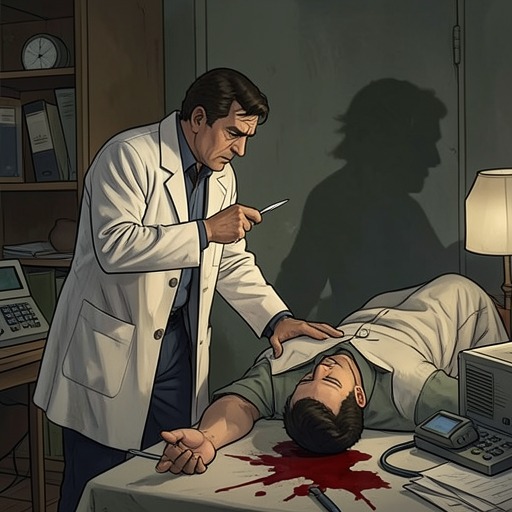
Cody asks Ben to help turn the body onto its belly and inspects it closely. This is not a ceremonial or purely emotional encounter with death; it is an examination governed by professional procedure, physical evidence, and the expectation that the body may disclose a cause. Later, at Green’s Mortuary, he examines Marjorie Glick after her death and notes that her condition resembles Mike Ryerson’s: there is no surface lividity and no sign of rigor or incipient rigor. He refuses to commit himself while several hours may still decide the matter, but the repetition is unmistakable. Different deaths are producing bodies that do not behave as recently dead bodies should.
The institutional setting around these examinations reinforces the conflict between administrative order and supernatural disorder. A medical examiner arrives with an assistant and a camera; the sheriff questions Cody and Ben while deputies dust for fingerprints and take photographs. The town attempts to process the crisis through morgues, police notebooks, hospital records, and forensic observation. Cody is one of the few figures able to recognize that the accumulating irregularities are connected, even before the institutions possess a vocabulary for the connection.
From Physician to Vampire Hunter
The turning point is the theft of bodies from the Cumberland County Morgue in Portland. Cody hears that someone has removed the corpses, an occurrence described through the imagery of a Boris Karloff film and Mary Shelley. The event expands the crisis beyond isolated deaths: bodies are now being taken from official custody, and the dead have become active resources in the outbreak. Cody’s medical world can no longer contain the problem within diagnosis or mortuary procedure.
He subsequently works with Ben Mears and Mark Petrie in direct opposition to the vampires. When Roy McDougall’s car is found at the trailer lot on the Bend Road during a weekday, Cody suspects that something is wrong. He arrives in the rain carrying his black medical bag, while Mark brings freshly sharpened stakes and a hammer with a two-pound head. Cody tests the trailer and, finding the storm door locked, asks for the hammer. The doctor’s instruments and the hunter’s weapons now share the same operation: investigation has become intervention.
Cody and Mark pull Roy McDougall out from a crawl space into the weakening daylight. Once fully exposed, Roy writhes, emits steam and moisture, sags and yellows, rolls his eyes beneath closed lids, and shows teeth like those of a large dog. His Cheyne–Stokes-like respiration begins in the light and stops when he retreats into shadow. Cody observes these changes medically, but the observation no longer serves a conventional diagnosis. It confirms that the body is an undead predator whose physiology responds violently to sunlight. Cody’s clinical attention therefore becomes a weapon: he documents the supernatural precisely enough to act against it.
Relationships and Narrative Role
Cody’s closest working relationships are with Matt Burke, Ben Mears, and Mark Petrie. Matt supplies the older teacher’s trust and the initial questions about Danny’s illness; Ben becomes the witness who sees Cody’s composure during the examination of Mike’s body and relies on his judgment; Mark provides the youthful decisiveness and physical means needed for the daylight attack on Roy McDougall. Cody’s role joins these different forms of knowledge: Matt’s literary and historical understanding, Ben’s investigative persistence, Mark’s instinctive grasp of vampire rules, and Cody’s medical observation.
His relationship with Ben also develops through shared responsibility. Cody and Ben sit with Marjorie Glick at Green’s Mortuary, where they confront the possibility that her apparent death is not final. Cody’s request to remain with her downstairs turns medical attendance into vigilance. The mortuary is simultaneously a place of care, evidence, and danger, and Cody’s presence acknowledges that the dead may require protection from the living as much as the living require protection from disease.
Cody’s narrative importance comes from his movement across categories. He is not merely the town doctor who supplies exposition, nor is he simply a rational skeptic defeated by the supernatural. He begins by applying ordinary medicine to extraordinary symptoms, protects patient confidentiality, and proceeds through observation rather than theatrical revelation. As the evidence accumulates, he updates his understanding and accepts that the bodies he studies belong to a different order of existence. The novel thus makes medical expertise neither wholly sufficient nor useless: diagnosis fails when it remains inside conventional categories, but disciplined attention helps expose the hidden rules of the vampires.